
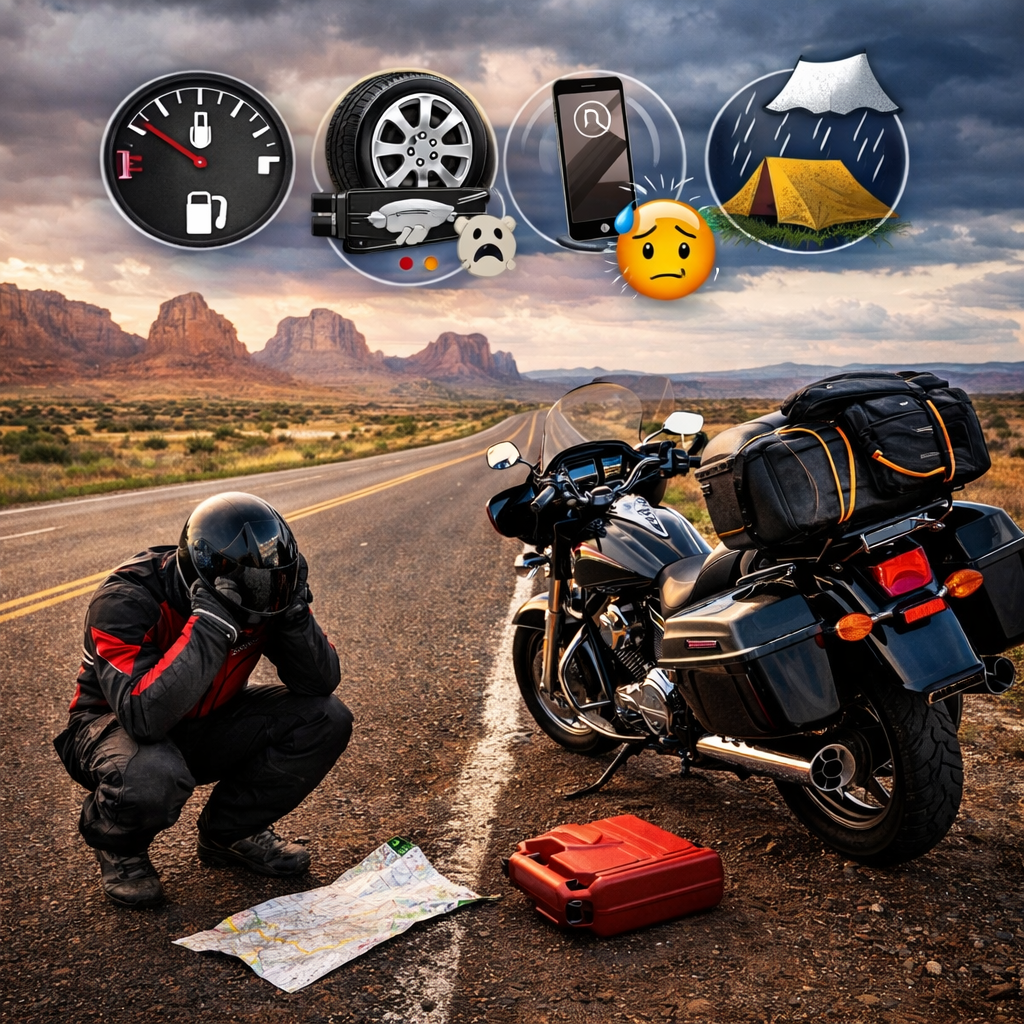
Most motorcycle long distance trip mistakes don’t happen on the road — they happen in the planning phase, or rather the lack of it. The errors that cut trips short or turn them dangerous are almost always preventable with the right preparation mindset.
Best by Scenario:
- First long trip, solo rider: Focus on mistakes 1, 3, and 7 first — these are the most likely to end your trip early
- Returning rider after a long break: Mistakes 4 and 9 will catch you off guard faster than anything else
- Experienced day rider going long for the first time: Mistakes 2, 5, and 6 are where day-ride habits become long-trip liabilities
Counterintuitive Insight: The riders who get into trouble on long trips are rarely the least skilled. They are usually the most confident — experienced enough to underestimate the demands of multi-day riding, not experienced enough to know what they don’t know.
Your First Long Trip Is Closer to Failing Than You Think
You’ve done the day rides. You’ve handled rain, traffic, and the occasional gravel patch without incident. You know your bike, you trust your gear, and you’ve been planning this trip for months. You feel ready.
What you probably don’t feel ready for is day three, 400 miles from home, with a saddle sore that’s making every mile feel like punishment, a tire that’s been slow-leaking since yesterday, and a daily mileage target that was always too ambitious but looked fine on a spreadsheet.
I’ve been riding long distance for over a decade. I’ve done solo trips across the American Southwest, multi-week tours through mountain corridors, and enough overnight runs to know exactly where new riders come apart. I’ve also made most of the mistakes on this list personally — some of them more than once.
The motorcycle long distance trip mistakes that end tours early or turn adventures into ordeals are almost never about riding skill. They’re about planning, pacing, and a handful of deeply ingrained habits that work fine for short rides and quietly destroy long ones.
Here is exactly what those mistakes are, why they happen, and how to stop them before they stop you.
How I Evaluated This
This list is not based on forum polls or aggregated Reddit opinions. It’s built from three sources: my own direct experience across roughly 80,000 long-distance miles, conversations with riders at the point of failure — roadside, at mechanic shops, at campgrounds where someone’s trip had just gone sideways — and a close reading of what the actual consequences of each mistake are, not just the theoretical risks.
What I weighted heavily:
- Frequency: how often does this mistake actually occur on first long trips
- Severity: does this mistake end the trip, or just make it worse
- Preventability: is this something a new rider can realistically fix with better preparation
What I excluded:
Pure skill errors — target fixation, poor braking technique, countersteering problems — are not on this list. Those are riding instruction topics, not trip preparation topics. This list is specifically about the decisions made before and during a long trip that new riders consistently get wrong.
The mistake most mistake-lists make: They focus on dramatic failures — crashes, breakdowns, emergencies. The reality is that most long trips don’t end dramatically. They end with a rider who is exhausted, uncomfortable, and quietly deciding to cut the route short and go home. The mistakes that cause that quiet failure are less exciting to write about and far more common.
Mistake 1: Planning Miles Instead of Hours
This is the single most common motorcycle long distance trip mistake I see, and it compounds every other problem on this list.
New riders plan daily mileage the way they plan a road trip in a car. Three hundred miles looks reasonable — maybe five hours of driving. On a motorcycle, 300 miles of varied terrain, with fuel stops, rest breaks, meals, and the genuine physical demands of riding, is closer to eight or nine hours of commitment. Do that for three days in a row and you’re not on a motorcycle trip anymore — you’re on an endurance test.
The real planning unit is hours in the saddle, not miles on the map. A sustainable daily riding window for most new long-distance riders is four to six hours of actual moving time. Not four to six hours of elapsed time — moving time. Factor in everything else and you’re looking at an eight to ten hour day for 250 to 300 miles.
Real-world constraint: Mountain roads, coastal routes, and any road worth riding on a motorcycle will cut your average speed significantly below what mapping apps predict. Google Maps does not know that you will slow to 30 mph through 15 miles of switchbacks, or that you will stop three times to photograph something that didn’t exist on the satellite view.
Build your daily targets around hours, not miles. If you want to ride six hours a day, figure out your realistic average speed for the terrain and work backward. Then subtract 20 percent for the variables you haven’t accounted for yet.
Mistake 2: Ignoring Saddle Time Conditioning
If your longest single ride before your first long trip is three hours, your body is not prepared for what six hours a day for five days will do to it.
Long-distance riding loads specific muscle groups — your lower back, hip flexors, and shoulders — in ways that short rides don’t. It also creates sustained vibration exposure, wind fatigue, and concentration demands that accumulate across days in ways that a single long ride won’t fully reveal.
The saddle sore problem is real and widely underestimated. Pressure sores from sustained sitting can become genuinely debilitating by day three or four of a long trip. They are not a minor inconvenience — they are a trip-ending condition if they develop seriously. Preventing them requires a combination of proper seat height and fit, quality riding pants with protective padding, anti-friction products (bodyglide or equivalent), and standing on the pegs regularly to redistribute pressure.
What works: In the six weeks before your first long trip, do at least two rides of four hours or more. Not to build calluses specifically, but to identify your weak points — where you stiffen up, where you lose focus, where you start compensating with bad posture — before you’re 200 miles from the nearest town.
Who this hits hardest: Riders coming from sport bikes with aggressive forward seating positions. The geometry that feels fine for an hour becomes a lumbar problem by hour four. If your long trip involves a different riding position than your daily riding, this gap catches you fast.
Mistake 3: Underestimating Weather Variability
A new rider planning a long trip in July thinks: summer, hot, pack light. This is a reliable path to being cold, wet, and miserable within the first two days.
Weather on a multi-day, multi-state motorcycle trip is not the weather at your departure point. It is the aggregate of every micro-climate, elevation band, and weather system you pass through across your entire route. A morning departure in 75-degree sunshine can put you in 45-degree mountain rain by early afternoon without a single forecast anomaly.
The elevation trap is especially common. Riders planning trips through the Rockies, Appalachians, or Sierra Nevada will experience temperature drops of 20 to 30 degrees Fahrenheit between valley floors and mountain passes. If you packed for valley temperatures, you are underdressed for every pass on your route.
The layering failure: Most new riders pack one heavy jacket and nothing else for cold management. The correct approach is a base layer, a mid layer, and a shell — all of which can be added or removed at fuel stops as conditions change. A single heavy jacket gets you through a narrow temperature range. A three-layer system gets you through a 40-degree range with the same packed volume.
Real-world constraint: Waterproof gear matters more than warm gear. You can tolerate cold if you are dry. Cold and wet simultaneously is the combination that creates hypothermia risk and forces stops. Invest in genuinely waterproof outer layers before a long trip, not water-resistant ones. The difference becomes obvious within 20 minutes of sustained rain.
Mistake 4: Skipping the Pre-Trip Mechanical Check
Your bike has been running fine. You rode it last weekend. What could have changed?
Quite a bit, actually — and more importantly, long-distance riding exposes mechanical marginal conditions that short rides absorb without consequence. A tire that’s at the low end of its wear range and fine for day rides will be illegal and dangerous after 2,000 miles of loaded long-distance riding. Chain stretch that’s imperceptible on a commute becomes a handling problem when you’re carrying luggage at highway speeds in crosswind.
The pre-trip checklist that actually matters:
- Tire condition and pressure — not just inflation, but tread depth and sidewall condition. If you’re within 1,500 miles of needing new tires, replace them before the trip, not after.
- Chain tension and lubrication — check tension cold, lubricate the night before departure
- Brake pad thickness — front and rear. Carry the part number for your bike’s pads so you can source them on the road if needed.
- All fluid levels — coolant, brake fluid, oil. Check brake fluid color; dark brown fluid is degraded and affects braking performance.
- Lights — all of them, including brake light activation from both levers
- Battery condition — a battery that starts your bike reliably every morning may fail after three days of accessories drawing current overnight
The mistake inside the mistake: New riders check the obvious things and skip the ones that require slightly more effort. Brake fluid and tire sidewalls get ignored far more often than oil levels. Those are also the ones that create serious safety consequences when they fail.
Mistake 5: Packing Too Much — and Packing It Wrong
There is an almost universal tendency among new long-distance motorcycle riders to overpack by 30 to 50 percent on their first trip. I did it. Everyone I know did it. The instinct is understandable — you’re going far from home for an extended period and you want to be prepared for everything.
The consequences are more serious than inconvenience. Excess weight changes your bike’s handling characteristics meaningfully, especially in corners and during slow-speed maneuvers. Improper weight distribution — too much weight high and to the rear — creates instability that new riders often misattribute to the road surface or their own skill.
The weight distribution rules that matter:
- Heavy items low and centered — dense items in the bottom of panniers, not on top of a tail bag
- Left-right balance matters — asymmetric loading creates a persistent lean that fatigues you and affects handling
- Nothing on the tank bag that obstructs your view of the instruments or your ability to move freely
- Test your fully loaded bike in a parking lot before you leave — slow speed maneuvers, U-turns, emergency stops
What to actually cut: The second helmet, the full-size towel, the backup pair of boots, the physical paper maps when your phone has offline capability, and the “just in case” tools you don’t know how to use. Every kilogram you remove is a handling improvement and a fatigue reduction.
Real-world constraint: Soft luggage shifts under load in ways that hard cases don’t. If you’re using soft bags, overpack them slightly so they hold their shape, and check straps every morning. A soft bag that shifts during riding can contact a hot exhaust pipe and create a fire risk within minutes.
Mistake 6: Riding Through Fatigue Instead of Stopping
Fatigue on a motorcycle is not just an endurance problem — it is a safety issue that new riders systematically underestimate because it arrives gradually and impairs the judgment needed to recognize it.
The symptoms riders ignore:
- Tunnel vision — your scan area narrows without you noticing
- Delayed reactions — you’re processing hazards a half-second slower than normal, which at 60 mph is 44 feet of additional stopping distance
- Micro-sleeps — brief losses of consciousness lasting one to three seconds, often experienced as a sudden awareness that you’ve covered ground without remembering it
- Irritability and poor decision-making — choosing not to stop because stopping feels like failure
Micro-sleeps on a motorcycle are potentially fatal. They are not rare. They happen to experienced riders, not just new ones, and they happen most commonly in the early afternoon post-lunch dip and in the late afternoon as the day’s riding accumulates.
The rule that works: Stop every 90 to 120 minutes regardless of whether you feel like you need to. Not just for fuel — get off the bike, walk around, eat something, let your nervous system reset. The stop that feels unnecessary is the one preventing the problem you haven’t noticed yet.
Who ignores this most: Riders with a daily mileage target they’re behind on. This is exactly why ambitious mileage plans are dangerous — they create pressure to ride through conditions that should be stopping you.
Mistake 7: Having No Roadside Emergency Plan
What happens if you get a flat tire at mile 180 of a 200-mile stretch with no cell coverage?
Most new long-distance riders have not thought through this question to a useful answer. “I’ll call someone” is not a plan in areas without cell service. “I’ll figure it out” is not a plan when you don’t carry repair tools and don’t know how to use them.
The minimum viable emergency kit for long-distance motorcycle riding:
- Tubeless tire plug kit and CO2 cartridges or a compact inflator — learn to use this before your trip, not during
- Basic tool roll matched to your bike’s fastener types — at minimum, the tools to remove your seat, access your battery, and make basic adjustments
- Emergency contact information written on paper, not just in your phone
- Roadside assistance membership (AMA, AAA Motorcycle, or manufacturer program) with the number saved and written down
- Offline maps downloaded before departure — apps like Maps.me or downloaded Google Maps regions work without cell signal
Real-world constraint: In remote areas of Nevada, Wyoming, Montana, and the desert Southwest, cell coverage gaps of 50 to 150 miles are common. Your emergency plan must work without a phone signal to be a real plan.
Mistake 8: Ignoring Nutrition and Hydration
Riding is more physically demanding than it looks from the outside, and the demands are invisible enough that new riders consistently under-fuel and under-hydrate across long riding days.
Wind exposure causes significant moisture loss even in cool weather. You don’t sweat visibly, so you don’t feel dehydrated — but you are. In summer heat, dehydration can reach meaningful levels within two to three hours of riding without fluid intake.
The cognitive impact arrives before the physical one. Mild dehydration — just 1 to 2 percent of body weight in fluid loss — measurably impairs reaction time, concentration, and decision-making. On a motorcycle, those are exactly the faculties you cannot afford to compromise.
The practical fix: Carry a minimum of one liter of water accessible without stopping — in a tank bag, a hydration pack under your jacket, or a handlebar-mounted bottle. Drink at every fuel stop whether you feel thirsty or not. Eat real food at midday rather than skipping a meal to make time. Bonking on a motorcycle is as real as bonking on a bicycle.
Mistake 9: Underestimating Mental Fatigue on Solo Trips
Physical fatigue gets all the attention. Mental fatigue on long solo motorcycle trips is equally real and far less discussed.
Sustained concentration, continuous navigation decisions, traffic management, and the sensory demands of long-distance riding create mental load that accumulates across a multi-day trip differently than physical tiredness. By day three or four of a solo trip, many new riders experience a low-grade cognitive fog they don’t recognize as fatigue because they’re not sleepy — they’re just slower, flatter, and less sharp.
What helps:
- Vary your riding environment deliberately — mix highway stretches with back roads to change the type of attention required
- Build in at least one full rest day on trips longer than five days
- Have genuine non-riding activities planned at some stops — a museum, a meal that takes time, a walk. Sitting in a motel room is not recovery.
- Ride with someone for part of the trip if possible — social interaction during rest periods significantly reduces the cognitive cost of solo travel
Mistake 10: Not Knowing When to Quit — or When to Push Through
This last mistake cuts both ways, and getting it right is what separates riders who develop good long-distance judgment from those who stay perpetually cautious.
The failure mode in one direction: Riders who quit too easily. Every long trip has a low point — usually around day two or three — where the novelty has worn off, the discomfort is real, and home sounds reasonable. Many riders abandon trips at exactly this point that would have become their best riding memories if they’d continued another 24 hours.
The failure mode in the other direction: Riders who push through conditions they shouldn’t. Riding fatigued because the schedule demands it. Continuing into deteriorating weather because turning back feels like failure. These are the decisions that produce accidents and emergencies.
How to tell the difference:
| Signal | What It Usually Means |
|---|---|
| General discomfort, mild fatigue | Normal long-trip adjustment — rest and continue |
| Specific pain that’s worsening | Stop, assess, address before continuing |
| Weather looks threatening ahead | Check forecast, prepare alternate route |
| Two near-misses within the same hour | Stop immediately — do not continue that day |
| Behind on miles and feeling pressure to ride faster | Reset your plan, not your risk threshold |
| The trip feels harder than expected | Almost always temporary — give it one more day |
The Mistake That Underlies All the Others
Every motorcycle long distance trip mistake on this list shares a common root: treating a long trip as a scaled-up version of a short one.
It isn’t. A long trip is a different activity. It rewards different preparation, different pacing, different decision-making, and a fundamentally different relationship to discomfort and uncertainty.
The adjustment is learnable, and the lessons stick. Most riders who make these mistakes on their first long trip don’t make them on their second — because the first trip, even when it goes wrong, teaches things that no amount of pre-trip reading can fully replace.
So here is the honest trade-off: you can prepare carefully, address the ten mistakes on this list, and still have things go unexpectedly wrong. Or you can ignore the list entirely, ride on instinct, and occasionally get lucky. Neither approach is complete.
The right move is to prepare for the mistakes you can prevent, stay adaptable for the ones you can’t, and accept that some friction is not a failure of planning — it is the texture of the thing itself.
The riders with the best long-trip stories are rarely the ones who prepared perfectly. They are the ones who prepared well enough, paid attention, and adjusted when the road told them something their plan didn’t anticipate.
Your plan will be wrong in at least two ways you haven’t identified yet. Go anyway.